
Press
Video






Manu Prakash is a physical biologist applying his expertise in soft-matter physics to illuminate often easy to observe but hard to explain phenomena in biological and physical contexts and to invent solutions to difficult problems in global health, science education, and ecological surveillance.
The MacArthur Fellowship is a $625,000, no-strings-attached grant for individuals who have shown exceptional creativity in their work and the promise to do more. Learn more at www.macfound.org/macfellow and explore their stories on social media with the hashtag #MacFellow.
PPE is one of the most important protective layers for healthcare workers around the world in a crisis like COVID-19. Many hospitals have already run out of N95 masks and other PPE, including face masks, face shields and elastomeric respirators. Doctors are trying to reuse and ration masks. The industrial supply chain is unable to scale up to meet current demands. In the US and globally, there is an urgent need for fast stopgap solutions to meet the current demands for PPE. One place to focus is to integrate a face shield and N95 mask together into a single unit which makes for a faster gowning and degowning - while also possibly making a reusable, autoclavable shield.
Perhaps you've punched out a paper doll or folded an origami swan? TED Fellow Manu Prakash and his team have created a microscope made of paper that's just as easy to fold and use. A sparkling demo that shows how this invention could revolutionize healthcare in developing countries ... and turn almost anything into a fun, hands-on science experiment.
TEDTalks is a daily video podcast of the best talks and performances from the TED Conference, where the world's leading thinkers and doers give the talk of their lives in 18 minutes (or less). Look for talks on Technology, Entertainment and Design -- plus science, business, global issues, the arts and much more.
Find closed captions and translated subtitles in many languages at http://www.ted.com/translate
Follow TED news on Twitter: http://www.twitter.com/tednews
Like TED on Facebook: https://www.facebook.com/TED
A simple recording of a mosquito’s buzz on a cell phone could contribute to a global-scale mosquito tracking map of unprecedented detail. The Prakash Labat Stanford, led by Manu Prakash, assistant professor of bioengineering, is looking for citizen scientists to contribute to Abuzz, a mosquito monitoring platform the lab developed to produce the most detailed global map of mosquito distribution. All that’s required is for as many people as possible to
submit audio recordings of mosquitoes they encounter. Visit Abuzz: http://abuzz.stanford.edu/
Using Mobile Phones as Acoustic Sensors for the Surveillance of Spatio-temporal Mosquito Ecology
Haripriya Mukundarajan, Felix Hol, Erica A Castillo, Cooper Newby, Manu Prakash
eLife, Oct 31, 2017
Music by Leanne Kelly: http://www.newspellmusic.com
Almost eight years ago, Stanford University bioengineer Manu Prakash was looking for a way to watch every cell in an adult living, behaving animal in elaborate detail. He searched the catalog of life and happened upon a simple marine animal called Trichoplax adhaerens – or Tplax, as Prakash has come to call it.
Read the Stanford News story: https://news.stanford.edu/2018/10/15/...
"Ultrafast epithelial contractions provide insights into contraction speed limits and tissue integrity," Shahaf Armon, Matthew Storm Bull, Andres Aranda-Diaz, and Manu Prakash: http://www.pnas.org/content/early/201...
Music: "Eternity" by Stellardrone:
Stanford News: http://news.stanford.edu/
Stanford University: http://www.stanford.edu/
Inspired by a whirligig toy, Stanford bioengineers have developed an ultra-low-cost, human-powered blood centrifuge. With rotational speeds of up to 125,000 revolutions per minute, the device separates blood plasma from red cells in 1.5 minutes, no electricity required. A centrifuge is critical for detecting diseases such as malaria, African sleeping sickness, HIV and tuberculosis. This low-cost version will enable precise diagnosis and treatment in the poor, off-the-grid regions where these diseases are most prevalent. For more information https://news.stanford.edu/2017/01/10/whirligig-toy-bioengineers-develop-20-cent-hand-powered-blood-centrifuge/
"Hand-powered ultralow-cost paper centrifuge", Nature Biomedical Engineering, M. Saad Bhamla, Brandon Benson*, Chew Chai*, Georgios Katsikis, Aanchal Johri, Manu Prakash, *equal contributor.
https://doi.org/10.1038/s41551-016-0009
Correspondence: (manup@stanford.edu)
A puzzling observation, pursued through hundreds of experiments, has led Stanford researchers to a simple yet profound discovery: Under certain circumstances, droplets of fluid will move like performers in a dance choreographed by molecular physics. Read the story: http://stanford.io/1A9EcAE
Music: "Interlude - In Anxious Shadows" by Kai Engel
Inventor Manu Prakash turns everyday materials into powerful scientific devices, from paper microscopes to a clever new mosquito tracker. From the TED Fellows stage, he demos Paperfuge, a hand-powered centrifuge inspired by a spinning toy that costs 20 cents to make and can do the work of a $1,000 machine, no electricity required.
The TED Talks channel features the best talks and performances from the TED Conference, where the world's leading thinkers and doers give the talk of their lives in 18 minutes (or less). Look for talks on Technology, Entertainment and Design -- plus science, business, global issues, the arts and more.
Follow TED on Twitter: http://www.twitter.com/TEDTalks
Like TED on Facebook: https://www.facebook.com/TED
explorebiology.org
Manu Prakash, professor at Stanford and founder of the Foldscope project, describes his early interest in science growing up in India and his passion for exploration. For more information, see the Narrative by Prakash in The Explorer's Guide to Biology (explorebiology.org/collections/cell-biology/the-nature-of-cytoplasm).
Manu Prakash, an assistant professor of bioengineering at Stanford, and his students have developed a synchronous computer that operates using the unique physics of moving water droplets. Their goal is to design a new class of computers that can precisely control and manipulate physical matter. For more info: https://www.youtube.com/redirect?event=video_description&redir_token=QUFFLUhqazM1a2VaXzU1a1F0OFA5ay1vTkF5bU50UHJUUXxBQ3Jtc0trRFpZb18zRVJYd0ZISVVFMEZmVjAyVjJ2QWdCb1BmbnRWSWpRVGZiS3FUX1prZmxIckItN05sbTBNMnNfbFJzUHJ5RlNmdlZfVGpDazNIeWlZSXZfQklxcVFoZ2lfOVowdmVGckZIVjZkRGhHM000TQ&q=http%3A%2F%2Fnews.stanford.edu%2Fnews%2F2015%2Fjune%2Fcomputer-water-drops-060815.html&v=m5WodTppevo
Music: “Union Hall Melody” by Blue Dot Sessions
In his talk, TED2010 Fellow and physicist Manu Prakash shows us how computation controls information and material through the project, Bubble Logic, using microfluidic bubbles and water to imitate computer circuitry.
Gizmologist Manu Prakash believes in the value of curiosity-driven science. In this insightful nugget of a talk, he shares the story of how a high school student with a question ended up making some fascinating observations about the physics of parasitology.
TEDArchive presents previously unpublished talks from TED conferences.
Enjoy this unedited talk by Manu Prakash.
Filmed at TED 2011.
NOTE: Comments are disabled on this video. We made this difficult decision for the TED Archive because we believe that a well-moderated conversation allows for better commentary from more people and more viewpoints. Studies show that aggressive and hateful comments silence other commenters and drive them away; unfortunately, YouTube's comment moderation tools are simply not up to the task of allowing us to monitor comments on so many videos at once. (We'd love to see this change, YouTube.) So for now, if you'd like to comment on this talk, please use Facebook, Twitter or G+ to discuss with your networks.
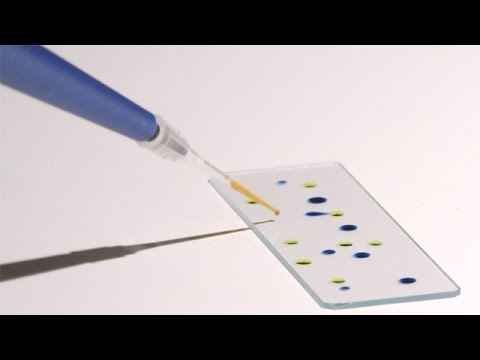
In this fascinating talk, TED Fellow Manu Prakash brings a science experiment to the TED stage - delving right into the potential of computing with fluids and the impact that it could have on how we manipulate matter. He explores this phenomena on the micro scale, using only glass slides, water and food coloring.
TEDArchive presents previously unpublished talks from TED conferences.
Enjoy this unedited talk by Manu Prakash.
Filmed at TED2015 Fellows Retreat.
NOTE: Comments are disabled on this video. We made this difficult decision for the TED Archive because we believe that a well-moderated conversation allows for better commentary from more people and more viewpoints. Studies show that aggressive and hateful comments silence other commenters and drive them away; unfortunately, YouTube's comment moderation tools are simply not up to the task of allowing us to monitor comments on so many videos at once. (We'd love to see this change, YouTube.) So for now, if you'd like to comment on this talk, please use Facebook, Twitter or G+ to discuss with your networks.
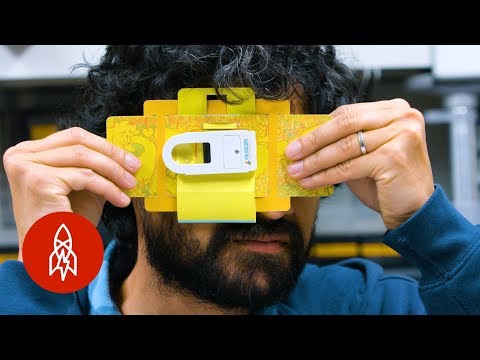
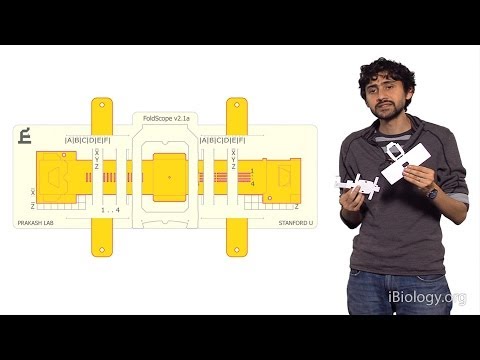
The Foldscope is a fully functional microscope that can be laser- or die-cut out of paper for around 50 cents.
This bookmark-sized microscope can be assembled in minutes, includes no mechanical moving parts, packs in a flat configuration, is extremely rugged and can be incinerated after to safely dispose of infectious biological samples.
With minor optics modifications, the microscope can be designed for brightfield, multi-flourescence or projection microscopy, or specialized to identify specific pathogens.
In this video, the Foldscope's creator Manu Prakash, PhD, discusses how his 50-cent microscope is being used to help identify, diagnose, and prevent malaria.
Read more about the story of Prakash, a bioengineer at Stanford, and his 50-cent microscope on the Stanford Medicine blog at http://stan.md/1dIp5qY
Manu Prakash and team are encouraging curiosity and motivating the next generation of scientists, inventors and innovators by providing a million microscopes to children all over the world.
Foldscope is a $1, pocket-sized, paper-based microscope that can magnify contents more than 2,000X. An active community of Foldscope users in more than 130 countries are currently using these microscopes to collect and openly share data and information focused on biodiversity, public health and environmental conservation.
Visit www.foldscope.com for more details, including how you can get a foldscope, too!
Inventor Manu Prakash thinks you can’t understand Earth’s big problems without looking at the (really) tiny things. So he created Foldscope: an origami microscope that brings science to people’s pockets. It costs less than $1 to build, is portable and weighs less than 10 grams. There are more than 500,000 Foldscopes out in the world, and Manu hopes they’ll forge communities of curious problem solvers.
This Great Big Story was made possible by UBS: https://www.ubs.com/global/en/wealth-...
SUBSCRIBE: https://goo.gl/vR6Acb
This story is a part of our Human Condition series. Come along and let us connect you to some of the most peculiar, stirring, extraordinary, and distinctive people in the world.
Got a story idea for us? Shoot us an email at hey [at] GreatBigStory [dot] com
Follow us behind the scenes on Instagram: http://goo.gl/2KABeX
Make our acquaintance on Facebook: http://goo.gl/Vn0XIZ
Give us a shout on Twitter: http://goo.gl/sY1GLY
Come hang with us on Vimeo: http://goo.gl/T0OzjV
Visit our world directly: http://www.greatbigstory.com
Talk Overview: What if every person in the world could carry a microscope around in their pocket? That is the idea behind the foldscope, a 50-cent print-and-fold paper mass produced microscope. Foldscopes can be made to perform brightfield, darkfield, fluorescence, and polarization microscopy, and can reach submicron resolution. With applications ranging from global health to citizen science and K-12 education, Manu Prakash and his team's goal is to get a foldscope in the hands of anyone, anywhere, interested in viewing the microscopic world. Learn more at foldscope.com
Speaker Biography: Manu Prakash is an Assistant Professor in Bioengineering at Stanford University, affiliate of the Stanford Woods Institute for the Environment, and a Pew Scholar. His lab applies techniques derived from soft-condensed matter physics, fluid dynamics, computer science, and bioengineering to study the structure and function of biological entities. Prakash was born in Meerut, India, where he earned a BTech in computer science and engineering from the Indian Institute of Technology in Kanpur. He then did his master's and PhD in applied physics at MIT before moving to Stanford.
Manu Prakash always yearned to know the why and the how of things. As a boy in India, he spent endless hours playing outside with animals and making flammable artifacts in an abandoned lab in the basement of his home. Having the chance to explore his surroundings with open-ended curiosity, he learned to find the sublime in the mundane. Today, as a world-renowned researcher and inventor at Stanford University, he continues to be inspired by these childhood lessons, and is creating low-cost tools to empower people around the globe to go on their own journey of science and discovery.